
Comprehensive Guide to Sizing Your PV System
Work through a five-step checklist to match your loads, batteries, inverter, and solar array so every component fits together the first time.
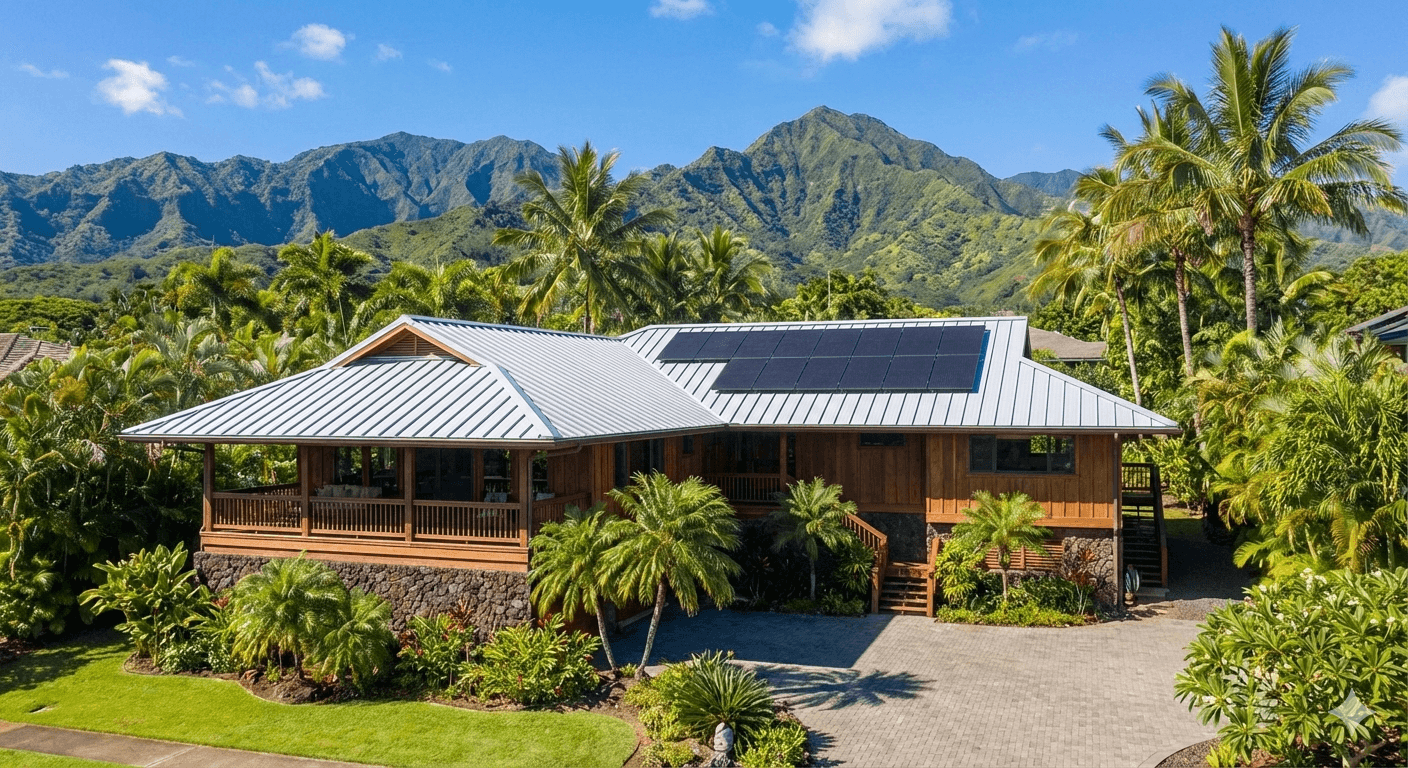
Maui's solar kits now span whole-home builds, off-grid cabins, van conversions, and RV-ready bundles. With so many options, the simplest path is to run through a step-by-step framework before you spend a dollar so your system works together on day one.
60-Second Electricity Lesson
Think of voltage as water pressure, amperage as hose thickness, and watts as the total water filling a bucket over time. Multiply volts × amps to get watts, and remember that watt-hours are watts × hours of runtime. A 100 W light bulb running for 10 hours needs 1,000 Wh (1 kWh) from your battery.
Step 1: Audit What You Need to Power
List every device, how many watts it draws, and how many hours per day you'll run it. Round the hours up for winter or guest usage and use your HECO bill if you're planning for a whole home. In our lab's tiny-cabin example the loads looked like:
Total: roughly 5,000 Wh per day.
Step 2: Size the Battery Bank (Daily Usage × Runway)
Decide how many days you need to ride through without charging—storm prep, visitor turnover, or shade. Multiply your daily watt-hours by that window. Josh limits stays to three days, so 5,000 Wh/day × 3 days = ~15 kWh of storage. Convert to amp-hours if you're working with 12/24/48 V batteries by dividing watt-hours by system voltage.
Step 3: Plan How You'll Recharge
If you're adding solar, figure out your peak sun hours (PSH). Maui averages 5–5.5 PSH, but designing with 4 PSH builds in bad-weather buffer. Divide the battery capacity by PSH to size the array: 15 kWh ÷ 4 PSH ≈ 3.75 kW, so spec a 4 kW array. Then choose panel wattage and quantity (4,000 W ÷ 400 W panels = 10 panels). If you're charging from the grid or a generator, focus on whether the AC input can refill the battery bank during your off-peak window.
Step 4: Match Inverter Output to Simultaneous Loads
Turn on everything you might run at once and note both the surge and continuous wattage. Josh's cabin peaks near 2,000 W and cruises at 1,200 W, so he needs an inverter with ≥2,000 W continuous output, 120 V AC, and enough PV input headroom (≥4,000 W). Larger homes may need split-phase 120/240 V or multiple inverters in parallel.
Step 5: Choose the System Type
In 2025–2026, all-in-one inverter-chargers are usually the easiest path because they bake in breakers, MPPT charge controllers, and programming (time-of-use charging, generator auto-start, etc.). Pick the mode that matches your site:
Step 6: Budget Where It Matters
Never undersize the inverter—it is the heart of the system and hardest part to swap. Batteries and panels, however, are intentionally modular. Start with half the batteries or solar array you eventually want, install the balance-of-system, and add modules later within the same battery family or panel string specs.
Vet Your Vendors
Kits from outfits like Signature Solar or Shop Solar include components they have already validated, arrive in one shipment, and come with live support. DIY shopping is doable, but double-check voltage ranges, connector types, and communication protocols before buying a mix of brands. Avoid leases; financing or staged purchases let you keep the incentives and long-term savings.
Quick Checklist Before Ordering
1. Daily watt-hour total and days of autonomy written down. 2. Peak sun hours (or AC charging window) and matching array/input size. 3. Inverter specs: continuous & surge watts, voltage, PV input, AC input. 4. System type selected (off-grid, hybrid, grid-assist). 5. Expansion plan for batteries/panels plus installer DIY contributions. Bring those numbers to your installer or use our [Solar Calculator](/calculator) to stress-test the design before you hit checkout.
Related Posts
Ready to Go Solar?
Get free quotes from top-rated Maui solar installers and start saving today.